
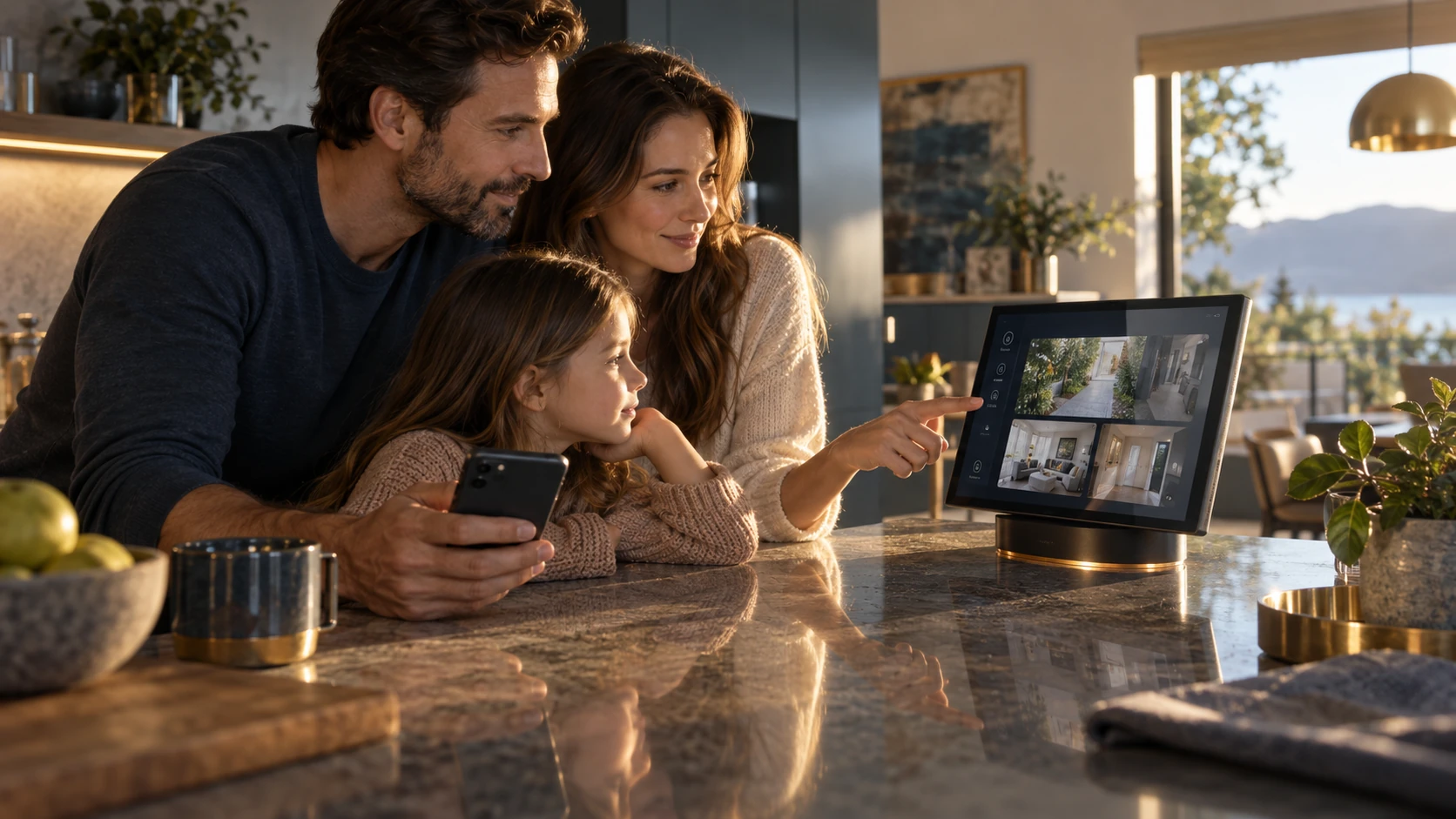
Apple announced HomeView on October 13, 2026, a 7-inch Liquid Retina smart home display powered by its A18 chip. A tabletop model combines a tilting display with a speaker base; a separate wall-mounted model is also planned. Both start at $299 in the United States. That is a U.S. price, not an Indonesian launch price or a rupiah quote.
Preorders opened in Australia, Canada, India, New Zealand, the United Kingdom and the United States on October 13. Singapore preorders begin on Thursday, October 15, at 9 a.m. SGT. Apple gives Friday, November 13, as retail availability in those markets, with South African sales through authorized resellers also due that day. Indonesia is not in the announced launch list. Apple explicitly says HomeView is not for sale in the European Union while Siri AI is unavailable there.
Siri AI on HomeView is an English-language beta in HomeView software 27.2 for the eight named countries, including South Africa. Canadian French is promised in a later update. This is a staged hardware and software launch, not a globally available final assistant.
Personal-context requests require a paired Apple Intelligence-enabled iPhone or iPad on the latest software, with Siri AI enabled and a supported language selected. Apple describes broader world-knowledge conversations and music discovery without an AI-enabled paired device, but those are not the same as personal-context access. Setup and multiuser support still require a compatible iPhone or iPad.
HomeView can recognize up to six enrolled users by their faces and show personal screens. It can display up to nine camera feeds, control HomeKit or Matter accessories, and make FaceTime calls with Center Stage. FaceTime requires compatible calling devices and Wi-Fi. Smart home accessories are sold separately; the nine-feed display limit is not a promise of nine AI-analyzed recording streams.
Video summaries and natural-language search for HomeKit Secure Video recordings require setup with an eligible Apple Intelligence iPhone or iPad and an eligible iCloud+ subscription. Supported camera counts depend on the plan and may change. Apple also states that some server-side AI features have daily limits and that expanded access will carry a fee in the future. The announcement does not establish free, unlimited cloud AI.
Apple says Secure Exclaves isolate camera and microphone processing and that Siri requests can use on-device processing or Private Cloud Compute. Those are vendor privacy claims, not an independent audit. Its statement that Private Cloud Compute request data is not stored should not be read as no conversation history: the Siri app uses iCloud to sync conversations across devices.
Personal information is normally tied to face recognition and a paired device that is present and recently unlocked. A footnote allows continued access after the paired device disconnects from Wi-Fi if it was recently on the same network, has an active cellular connection, remains in the same location and was recently unlocked. The release does not describe a blanket rule that leaving Wi-Fi instantly hides all personal content.
Expressive customizable Siri voices have narrower eligibility than general HomeView pairing. Apple lists iPhone Duo, iPhone 18 Pro models, iPhone Air, iPhone 17 Pro models, and M4-or-later iPads with at least 12GB of unified memory. The voices are English-only.
Wall mounts cost extra: Schneider Home USB-C and AC-wired options start at $59.95 and $79.95 in the United States. A $129.95 Power over Ethernet mount is scheduled for early 2027. Apple Home Collection cameras, thermostats and a lock are slated to start arriving in December 2026, with some accessories in early 2027; they are not already shipping as part of the $299 package.
The practical question is which features are available for a household's country, paired devices, language and subscription at delivery. Apple's announcement gives a November hardware schedule with a regional Siri beta and several later accessories, rather than one complete worldwide rollout.