
Ubitium announced $14 million in new seed funding on October 13, 2026 to develop processors for Physical AI. The company says the round brings its total seed funding to $18 million since its founding in 2024. Funding is not revenue or evidence that commercial chips are shipping.
Ibex Investors led the round, according to Ubitium. Participants include OpenOcean, KBC Focus Fund, Runa Capital and Inflection. Florian Seibel, co-founder and co-CEO of Quantum Systems, invested personally. The announcement does not identify Quantum Systems itself as a corporate investor.
The reported technical milestone is first silicon: Ubitium says its UB108 chip has demonstrated signal processing, AI inference and real-time control on one reconfigurable array. It describes 256 processing elements manufactured on Samsung's 8nm process. These details and the demonstration result are company claims, not independently tested performance findings.
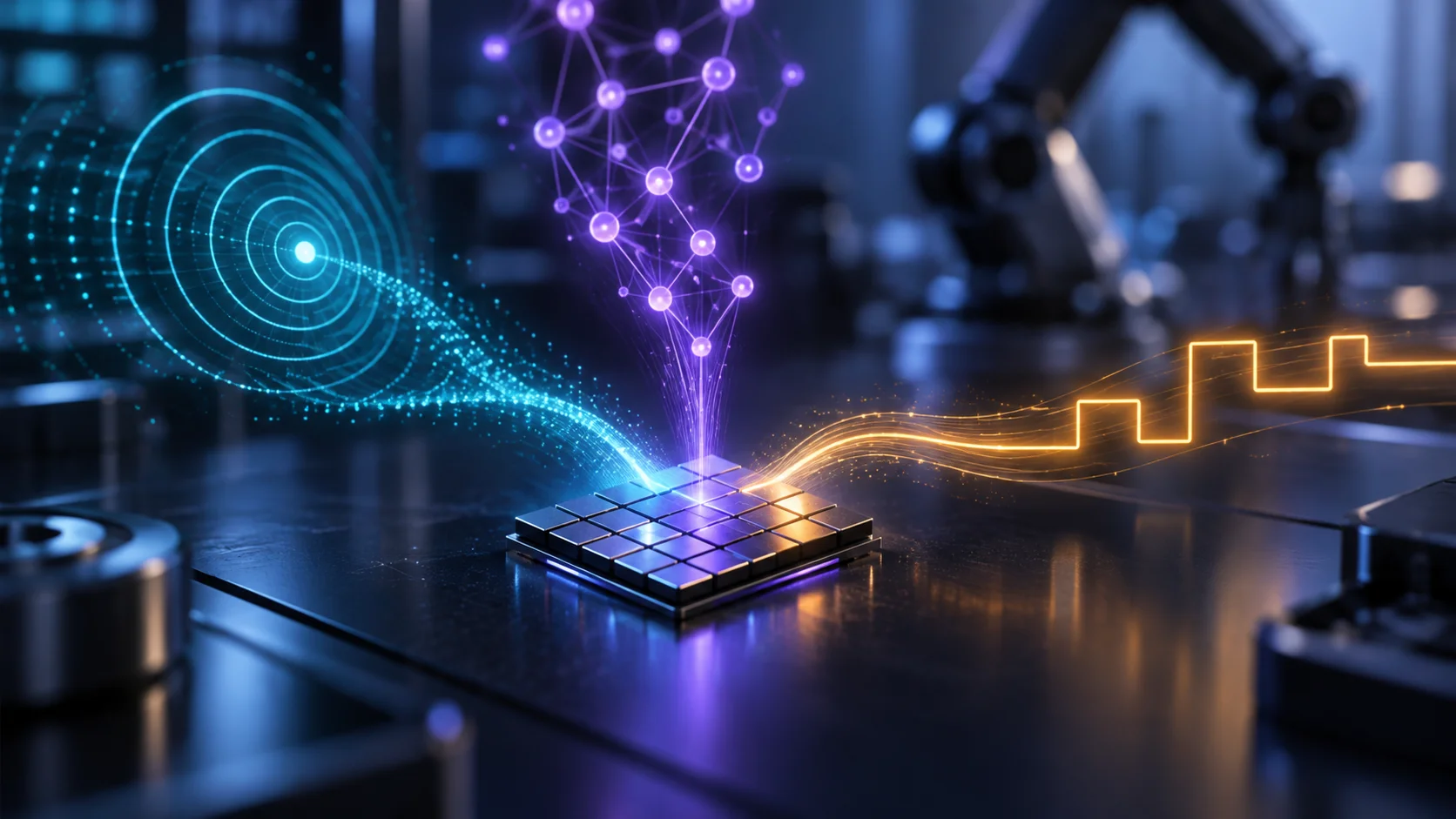
The proposed architecture targets the computing mix inside machines that sense and act. Ubitium wants a programmable array to replace combinations of a digital signal processor for sensing, a neural processing unit for AI and a CPU for control, with resources allocated across changing workloads.
Ubitium says unified memory and standard RISC-V development tools provide a common processor and toolchain. Reducing transfers between separate chips and simplifying development are design goals. The announcement does not supply independent throughput, power-consumption or cost comparisons proving those gains.
The larger UB410 is still a plan. Ubitium intends to tape out this commercial processor with 4,096 processing elements and deliver evaluation units in 2027. Evaluation hardware is not the same as confirmed mass-production shipments, and the reviewed source does not establish a commercial price or shipment volume.
The company describes initial customers working on high-resolution radar and audio systems, where signal processing and inference meet. Drones, robots, vehicles and industrial equipment are target applications for the broader sensing, inference and control loop. These targets are not proof of safety-certified autonomous operation.
This is an embedded-computing story rather than evidence of a data-center GPU replacement for large foundation models. The reviewed announcement offers no verified large-language-model benchmark, model-capacity result or independent comparison with current accelerators.
The useful distinction is between an early architecture milestone and a finished product. Manufacturers evaluating Ubitium would still need workload-specific performance, power, tooling, integration and safety evidence. The funding announcement alone does not settle those questions.
Source reviewed October 13, 2026: Ubitium company announcement https://www.ubitium.com/ubitium-raises-14-million-to-build-the-first-universal-processor-for-physical-ai/ . National or industry-first marketing and market-size projections are not treated as independently established. Verification time is stored in UTC in the feed. The hero is an original conceptual illustration, not a UB108 photograph, die layout or benchmark.