
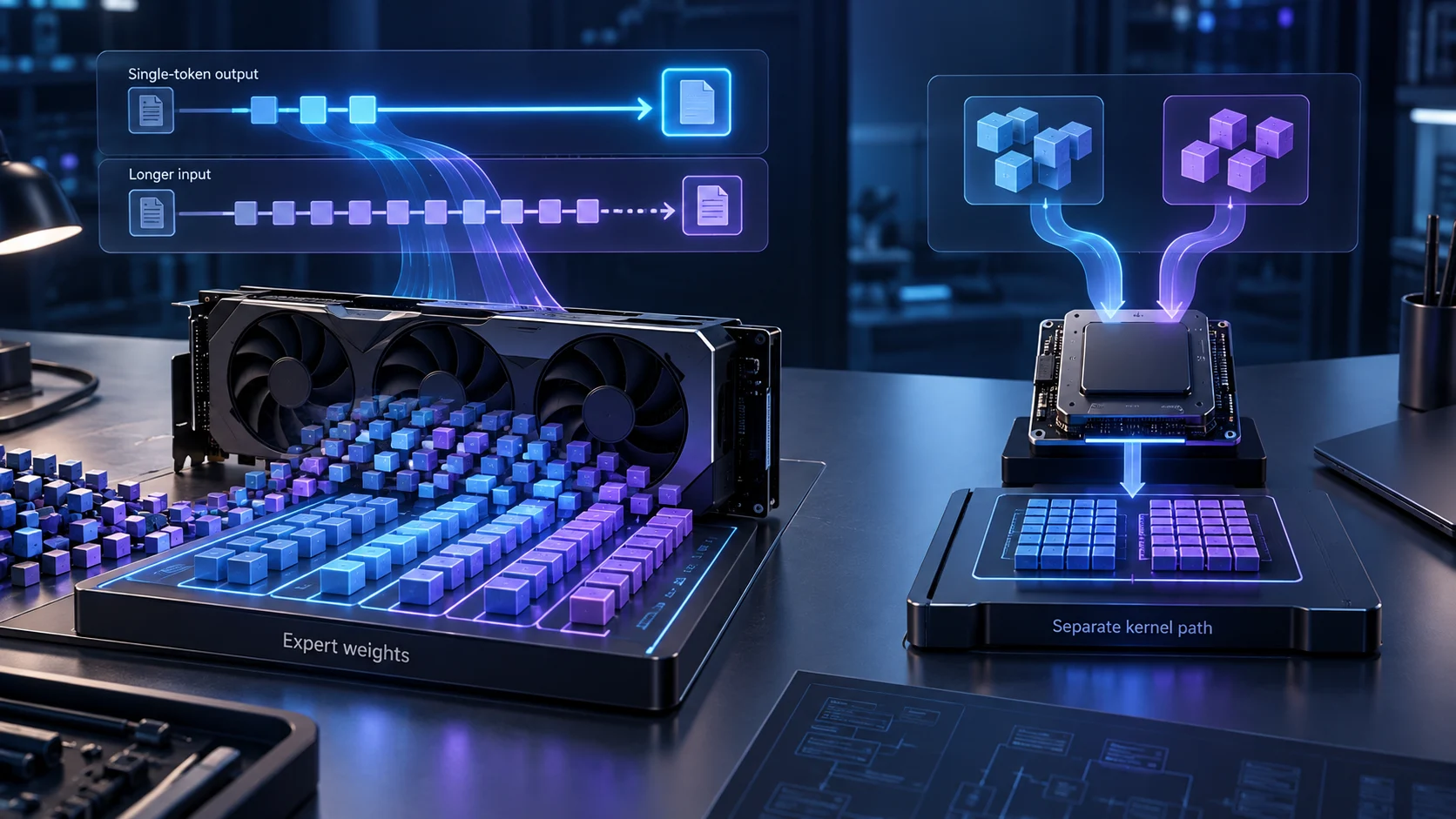
Local model inference is getting two backend-specific changes in llama.cpp, not a new set of model weights. An Intel SYCL optimization merged on October 10 targets MXFP4 mixture-of-experts workloads, while a separate OpenCL update adds Adreno kernels for Q4_K and Q6_K MoE operations. The practical result depends on which hardware and workload a user runs.
The SYCL change replaces table-based MXFP4 decoding with 32-bit arithmetic and adds lazy, per-expert weight reordering for aligned vector loads. The pull request says the arithmetic is bit-identical, caps temporary reorder memory at 32 MiB and retains a generic fallback for misaligned tensors. These are implementation changes aimed at a particular inference path, not a promise that every model runs twice as fast.
In the author's Intel Arc Pro B70 tests on Windows 11 with oneAPI 2026.0 and flash attention enabled, gpt-oss-20b decoding rose from 55.84 to 106.64 tokens per second. The gpt-oss-120b two-card test rose from 33.27 to 67.14 tokens per second. Those are roughly 1.91x and 2.02x results for generating tokens on those setups. They are project-contributor measurements, not tests rerun by AiBeamNews.
Prompt processing is a different workload. The author's initial gpt-oss-120b prompt result changed only from 594.5 to 600.1 tokens per second. A later rebase addressed test-order behavior and the author reported better B70 prompt throughput on another configuration. Neither result makes decoding and prefill interchangeable.
The final October 9 review makes the tradeoff visible on Arc A770. Decoding gains were about 32 to 40 percent, and small prompts improved, but 1,024- and 2,048-token prompt-processing tests still fell roughly 10 to 11 percent across the reported settings. A user who cares about long inputs could therefore see a different experience from the faster token-generation headline.
Another reviewer reported approximately 2.4x to 2.5x decoding on B60 and about 38 to 44 percent better large-prompt throughput, with settings and hardware distinct from A770. A B570 Windows test also reported a smaller model-level gain with partial GPU offloading. The discussion broadens the Windows hardware evidence, but does not establish Linux performance or a universal Intel result.
The author reports passing MXFP4 backend tests and gpt-oss-20b perplexity within baseline noise. Reviewers supplied additional checks on their configurations. These checks are useful evidence for the tested paths; they are not proof of correctness for all architectures, all models or every operating system.
The Adreno OpenCL change is separate. Pull request 30187 adds optimized binary kernels for MoE Q4_K and Q6_K operations and merged on October 10. It provides no numerical speed benchmark. The Intel decoding figures must not be attached to that Adreno update.
The upstream b11541 release, published October 10 at 08:02:57 UTC and marked as a pre-release, lists the Adreno kernel change. It follows the earlier SYCL change in the upstream release sequence. Its assets include Windows SYCL, Ubuntu SYCL and Snapdragon-oriented packages, but a listed download does not validate the benchmark on that platform.
The useful takeaway is to match the backend to the device and test the work that matters: token generation, input processing, memory use and output quality. This is an update to local open-weight inference infrastructure, not a new model launch or a universal twofold speedup.
Sources: upstream b11541 release, https://github.com/ggml-org/llama.cpp/releases/tag/b11541; Intel SYCL pull request and reviews, https://github.com/ggml-org/llama.cpp/pull/29809; Adreno OpenCL pull request, https://github.com/ggml-org/llama.cpp/pull/30187. Performance and correctness results are contributor-reported and were not independently rerun. The hero is an AI-generated conceptual illustration.
Source & limitations
Backend-specific changes, not new model weights. Roughly 2x Intel B70 decoding claims are contributor benchmarks on Windows; A770 long-prompt slowdown remains in final review. No Adreno speed figures; no Linux performance confirmation. b11541 marked pre-release. AI-generated conceptual illustration.
Read original source