
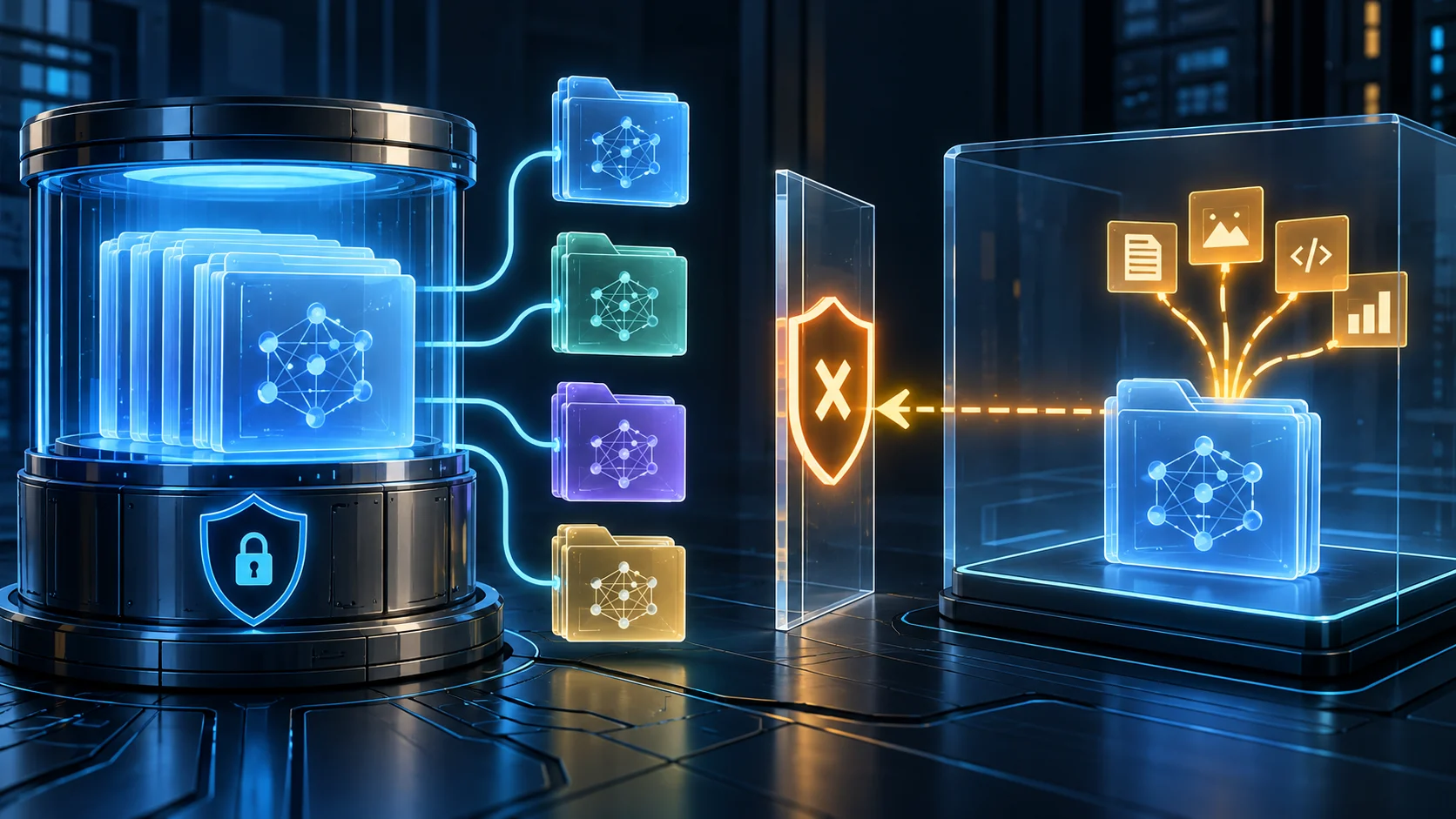
A local AI experiment can change more than the folder a user thinks they are editing. TensorFold 1.0.4 adds a safeguard for experimental Sliding Weights learning: it refuses model folders whose checkpoint shards, index or config.json are links to data shared with other files. The patch was published on October 10 at 00:27 UTC.
The release notes explain the specific problem. A folder created by tensorfold pull links its files into the Hugging Face cache. In version 1.0.3, learning in that folder could rewrite the cached original and every snapshot sharing the same data. Version 1.0.4 blocks that setup and tells users to serve a separately made copy instead.
This is a checkpoint integrity problem during a user-enabled learning workflow, not a report of a remote attacker compromising Hugging Face or stealing a model. The new check does not establish that an attack happened. It prevents an experimental feature from changing shared model data through linked files.
A hard-linked copy is also refused because it still shares the same underlying data. The release notes say an APFS clone passes the check and direct Mac users to the copy procedure in the Living Weights guide. The practical point is to use version 1.0.4 and an independent checkpoint copy before enabling Sliding Weights, rather than assuming another folder name means another model file.
Sliding Weights, introduced as experimental in 1.0.3, writes learned facts into changes to the model's output-projection weights and saves them in its safetensors shards. A server started from the changed folder can then answer with those facts after a restart. That differs from keeping a separate, easily editable conversation-memory record.
The project explicitly warns that nothing undoes a learned fact. Version 1.0.4's guardrail does not create an undo function. Preserving an unchanged original and keeping experiments in a separate copy therefore remains important even when the folder passes the new check.
Learning is limited to the Nemotron 3.5 Lightning MLX 4-bit checkpoint on an Apple-silicon Mac with enough memory, according to the 1.0.3 notes. NVIDIA GPUs refuse the learning mode, although the CUDA build can serve a folder that learned on a Mac. This should not be presented as universal on-device memory support across models and hardware.
The project's own small test also argues against treating the feature as dependable personal memory or a privacy guarantee. On a five-fact test document, it answered 5 of 11 recall questions and leaked a fact into 1 of 16 neighboring questions. Those results are reported by the project and do not establish general reliability.
Version 1.0.3 also added native Qwen3.8-27B support with a DFlash2 drafter and other runtime work. Its headline code speed of 151 tokens per second was a specific M5 Max test with drafting, not a universal result. The notes say plain 27B decoding without the drafter was slower than mlx_lm, prompt processing still trailed it and the 27B served one request at a time.
Version 1.0.4 changes no other code from 1.0.3, according to the release. The earlier known issues still apply. The narrow news is a useful safety check around file sharing, not a new learning breakthrough or a clean bill of health for every feature.
Sources: TensorFold 1.0.4 release notes, https://github.com/ashhart/TensorFold/releases/tag/v1.0.4; 1.0.3 feature notes and limitations, https://github.com/ashhart/TensorFold/releases/tag/v1.0.3. Performance and learning tests are project-reported. Use an independent checkpoint copy; learned facts have no undo.
Source & limitations
Experimental opt-in learning integrity safeguard, not a remote attack. Independent checkpoint copy and1.0.4still needed, no learned-fact undo. AppleSilicon learning only; small project tests, no reliability/privacy guarantee/universal151tok/sclaim. Prior known issues remain. AI-generated conceptual illustration.
Read original source