
A $1 billion lead pledge: NVIDIA, Anthropic and Crusoe expand the Genesis Mission push.
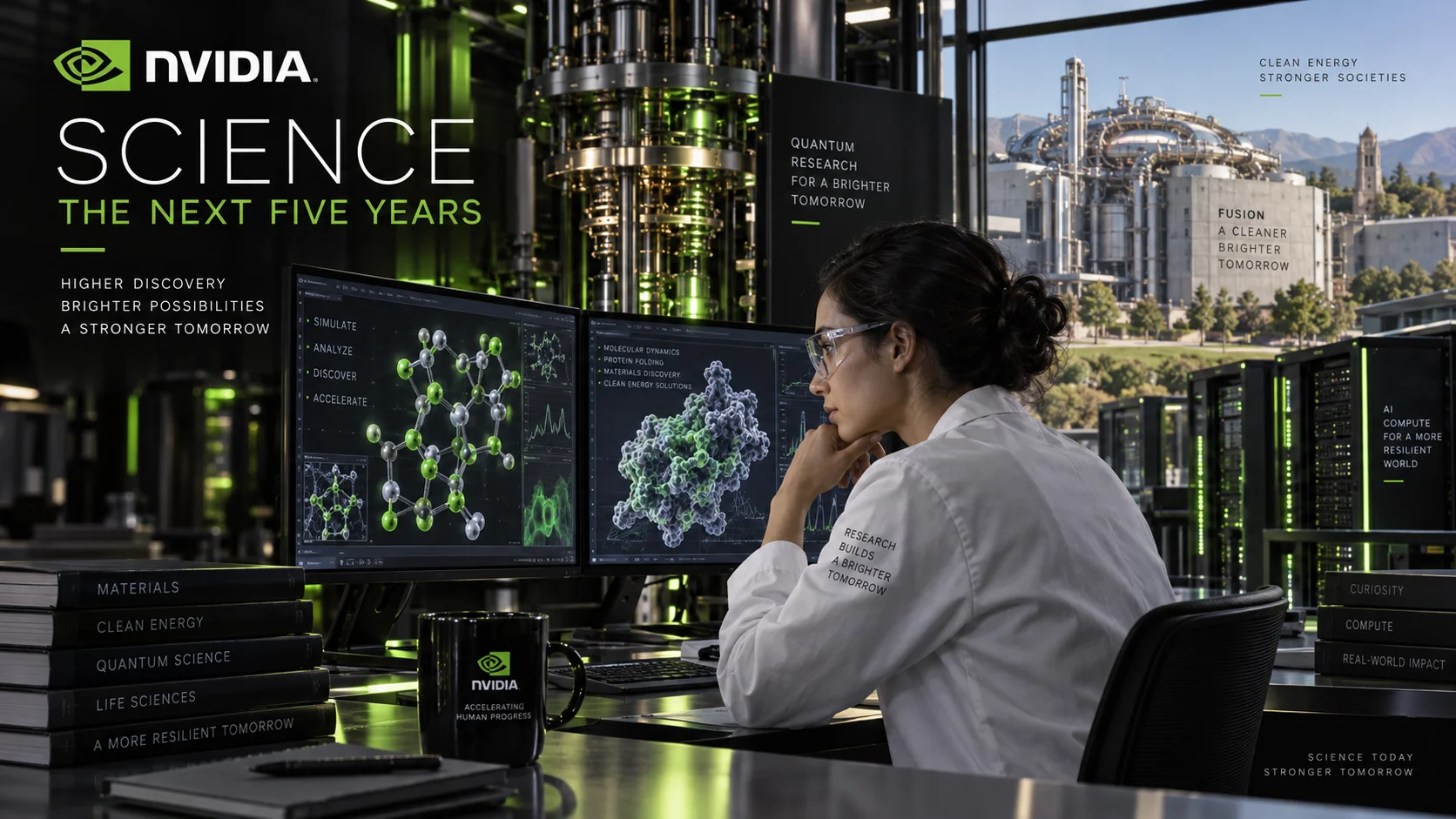
NVIDIA has announced commitments valued at $1 billion to advance US science over the next five years. The company made the announcement at the Science: A New Golden Age event in Washington, D.C., connecting its plans to the expansion of the US Genesis Mission.
Anthropic separately announced a $150 million commitment over three years to deepen its existing Genesis Mission partnership with the Department of Energy. The company says the support will make Claude available to more than 15 agencies, including credits for Claude, Claude Code and its API across several hundred projects, plus training, onboarding and technical support. This expands a partnership announced last December; it is not the start of an entirely new relationship.
Crusoe separately pledged $50 million in high-performance AI compute and inference credits over three years through Crusoe Cloud, alongside technical support for researchers across more than 15 federal agencies. Compute credits are access to services, not cash grants, and an announced pledge does not establish that all capacity has already been delivered.
The three announcements differ in form, beneficiaries and duration. NVIDIA describes five-year science commitments, while Anthropic and Crusoe describe three-year support with service credits and assistance. Adding the headline figures into one cash-funding pool would misrepresent what was announced.
The stated areas of support include higher-education research institutions, American quantum-computing development and cloud service providers supporting US government mission needs. NVIDIA names quantum computing, healthcare and energy security among the fields it wants to strengthen.
The figure is a multi-year commitment, not a statement that $1 billion has already been paid out. The release does not provide a complete allocation by recipient or a detailed disbursement schedule. It also does not establish that the full amount consists of cash grants rather than a mix of support and investment.
NVIDIA says it is collaborating on phase-two Genesis Mission projects in quantum computing, fusion, accelerator design and microelectronics. The company also points to its long-running work with US national laboratories and previously announced Department of Energy supercomputing plans. These are company descriptions of its collaborations, not independently measured scientific outcomes.
The release repeatedly uses the term super intelligence for its research ambitions. That language is not evidence that a general superintelligent system has been built or that promised breakthroughs have occurred. The concrete news is the announced research commitment and the areas it is intended to support.
NVIDIA explicitly classifies expectations around the commitments, technologies and partnerships as forward-looking and subject to risks and uncertainties. Delivery, scientific impact and the final distribution of resources will need to be tracked as the program develops.
Sources: NVIDIA via GlobeNewswire, https://www.globenewswire.com/news-release/2026/10/08/3377484/0/en/nvidia-commits-1-billion-to-advance-us-science-over-the-next-five-years.html; Anthropic, https://www.anthropic.com/news/genesis-mission-commitment; Crusoe via GlobeNewswire, https://www.globenewswire.com/news-release/2026/10/08/3377576/0/en/crusoe-pledges-50-million-in-compute-credits-to-white-house-ai-science-initiative.html.
Source & limitations
Separate multi-year company commitments, not a combined cash pool or funds fully disbursed today. Crusoe contribution is compute credits; Anthropic support expands its existing DOE partnership. Delivery, allocation and scientific outcomes remain forward-looking. No claim superintelligence has been achieved. Conceptual AI-generated editorial artwork, not a real funded lab or official product image.
Read original source