
Janas published version v2026.10.12.1 on October 12, adding a Windows x86-64 package alongside its Linux binaries. The local inference project has existed since September. The new angle is Windows access and a simpler way to benchmark a machine, not a newly created model or project on October 13.
The release provides a ZIP package for Windows 10 and 11 x86-64. The README specifies Windows 10 version 1903 or later. After unpacking, users can start janas-chat, while janas-get lists available models. Published packages include file checksums, which readers should verify against the official release rather than use an unknown mirror.
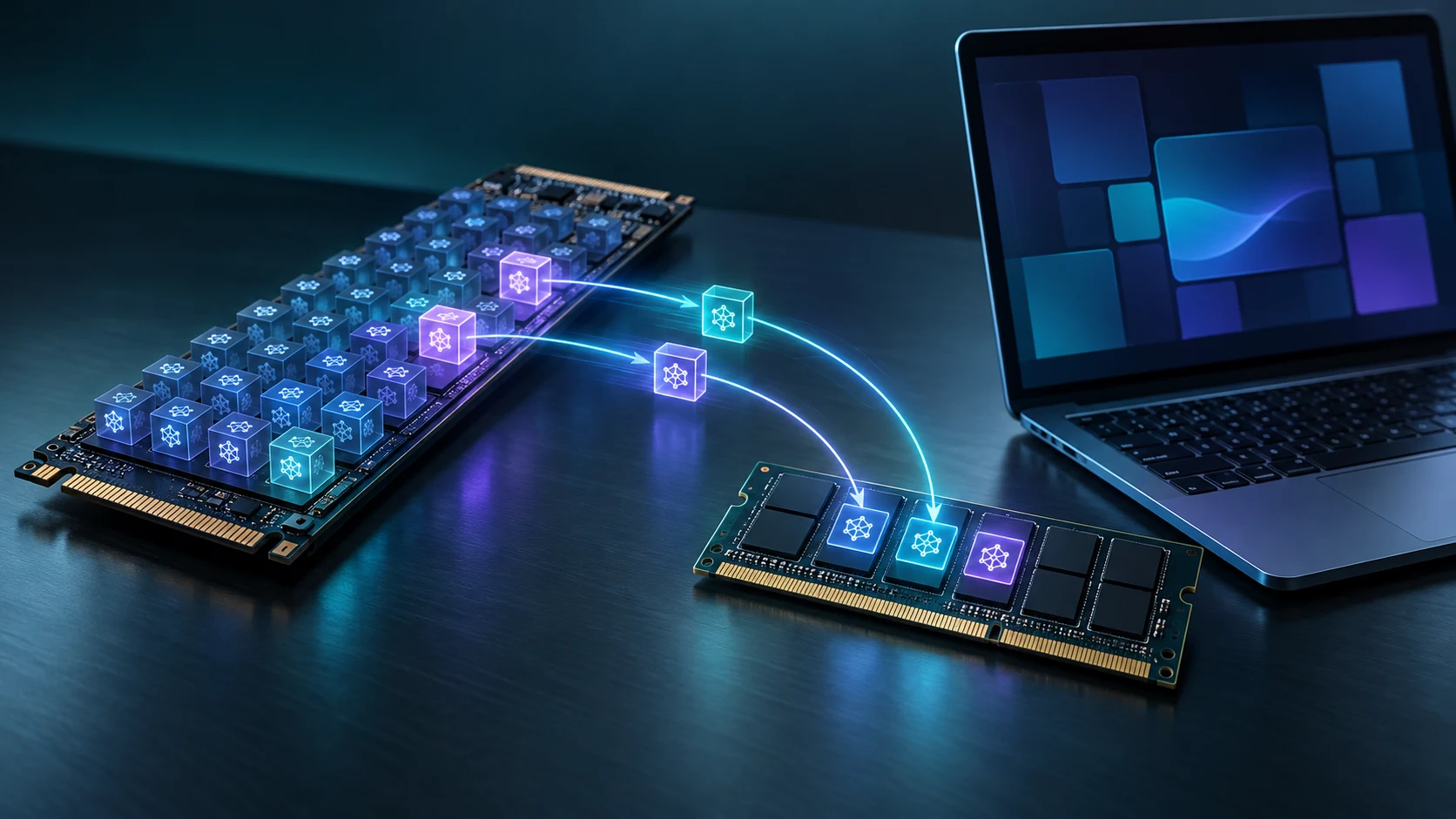
Janas-LLM runs mixture-of-experts models by leaving weights on disk, reading the experts needed for a token from an NVMe SSD and caching frequently used experts in RAM. This can make a model file larger than system memory usable without loading every expert at once. Disk throughput, cache headroom and model architecture still matter.
The updated janas-bench accepts a model name, offers a model list when none is given and asks before downloading a missing model. It also finds the prediction file used for speculative decoding, matching the chat setup. That gives users a way to measure their own system instead of treating the headline benchmark as a promise.
The project reports 24 output tokens per second for Qwen3-Next-80B-A3B, whose converted file is 48.4GB, in a comparison on its development laptop. A separate chat test reports up to 37 tokens per second with speculative decoding. The machine has a Core Ultra 9 185H, integrated Arc GPU, 32GB DDR5 and an NVMe SSD described as reading about 5.7GB per second.
Those large-model figures were measured on Linux on that laptop. The new Windows tests use the same laptop, but the published Windows figures cited in the README cover smaller Qwen3-4B and Qwen3-30B-A3B models. The release does not establish that the 80B model reaches 37 tokens per second on every 32GB Windows laptop.
The comparison uses a llama.cpp build from September 18 and different benchmark mechanics. The larger model also needed a special llama.cpp build and memory options. The authors explicitly say the tools do not measure in exactly the same way, and the largest-model comparison uses one round. These are developer results, not an independent comparison with every current alternative.
The project labels itself experimental. APIs and command-line options can change without notice. Its aggressive expert cache can push a busy desktop into swap, and the README reports a GPU driver reset during development. It recommends an idle-machine first test, a cache limit when needed and disabling GPU use as a troubleshooting option.
Speed modes need separate scrutiny. Expert skipping and other approximate paths can trade precision or agreement for speed, so it would be wrong to describe every mode as lossless. Speculative decoding results also depend on the text being generated and how often the larger model accepts the draft.
The engine is licensed under GPL version 3 or later. Model weights retain their own licenses; converting them into the project format does not replace those terms. Developers considering redistribution or commercial use should check both the engine obligations and the particular model license.
Sources: release https://github.com/prabanta-dev/janas/releases/tag/v2026.10.12.1 ; README https://github.com/prabanta-dev/janas ; change log https://github.com/prabanta-dev/janas/blob/main/ChangeLog.md . This article has not run the software or reproduced its benchmarks. The hero is an original conceptual illustration, not a hardware photograph or software screenshot.