
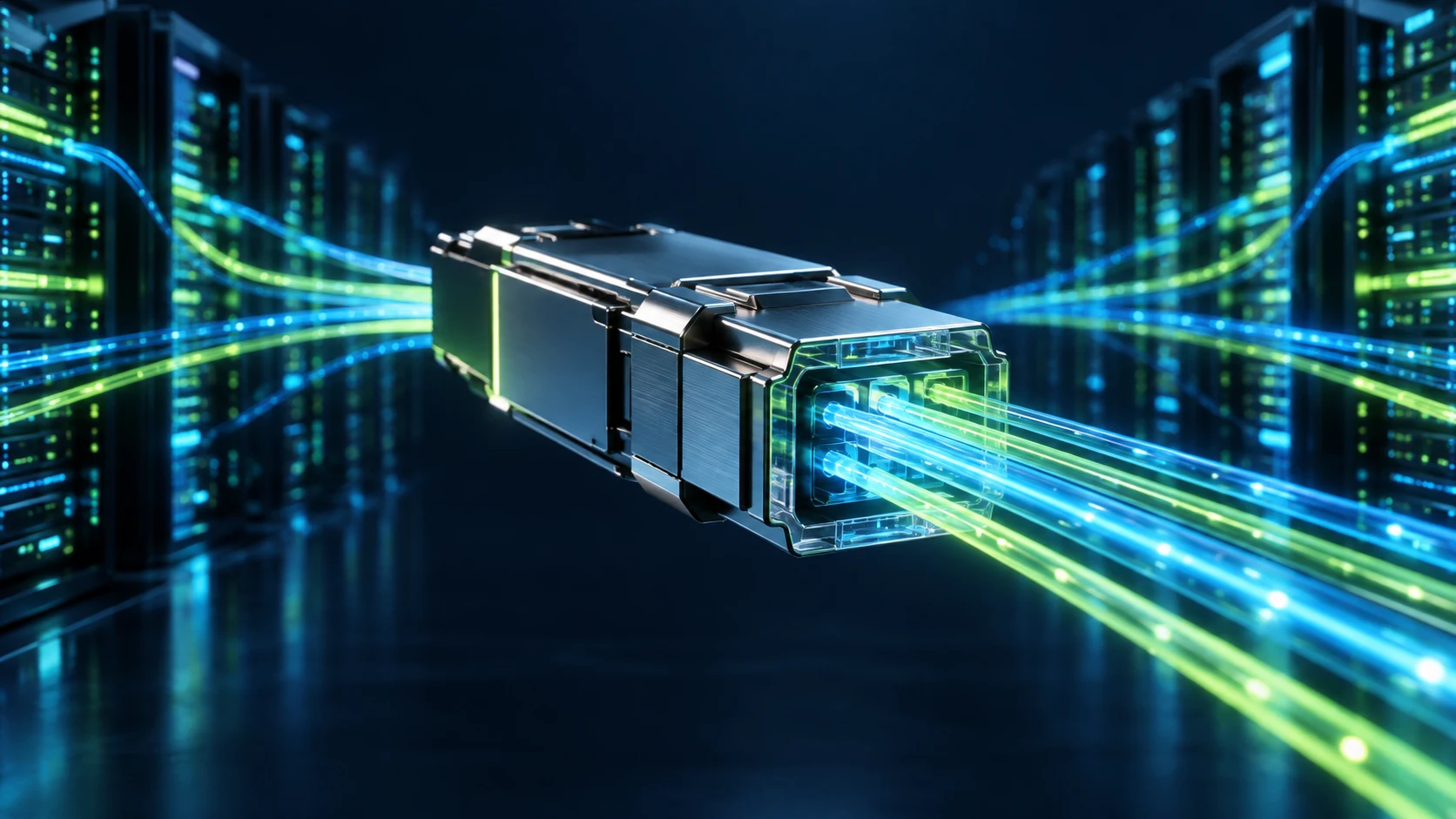
NVIDIA and Cisco announced plans on October 12 for USFP, short for Ultra-Dense Small Form Factor Pluggable. It is a proposed optical-module design for moving more data between computing systems in large AI networks. This is an infrastructure announcement, not a new AI model, a shipping notice or a finalized industry standard.
The design targets electrical signals of 400 Gb/s per lane. Cisco says the first planned transceivers will have 16 full-duplex lanes in a footprint comparable to OSFP, an existing optical-module form factor, with up to 12.8 Tb/s of overall capacity. Those numbers describe the planned connection capacity. They are not benchmark scores or a promise that an AI model will run a particular number of times faster.
Why does this matter? As more computers join an AI network, switches can run out of connection capacity. Expansion may then require extra switch layers and optical links. The companies want denser connections to support more systems without adding those network layers, while preserving the familiar practice of inserting and servicing removable optical modules.
Compared with pluggable modules using 200 Gb/s per lane, Cisco claims four times the bandwidth and front-panel bandwidth density, plus about 1.3 times the power efficiency. These are vendor design claims, not independent measurements in a deployed network. Better efficiency per bit also does not mean the same reduction in an entire data center's electricity bill.
The proposed connector uses a two-dimensional contact array and a two-step insertion design intended to engage high-speed contacts after insertion. Cisco says that should reduce contact wear and support future expansion to 32 full-duplex lanes or more. It also describes support for power dissipation up to 100 watts without a separate embedded cooling circuit in the transceiver. These are design specifications and intended benefits, not proof of field reliability.
TE Connectivity and Amphenol are working with NVIDIA and Cisco on cages, connectors and modules. NVIDIA and Cisco plan an open industry specification through an upcoming community-led multi-source project. A planned open specification is different from a specification already published and adopted by vendors.
For data-center planners, the useful takeaway is a possible future path to higher-capacity links within a similar front-panel footprint. Procurement still needs actual product availability, compatibility, measured power use and deployment terms. The release does not give a firm commercial delivery date or price, and existing equipment should not be assumed compatible solely because the footprint is comparable.
Source: Cisco announcement dated October 12, 2026 https://newsroom.cisco.com/c/r/newsroom/en/us/a/y2026/m10/nvidia-and-cisco-new-pluggable-optics-to-scale-ai-factories.html . Capacity, density and efficiency statements are attributed to Cisco and describe planned hardware. The hero is an original conceptual illustration, not a photograph or technical drawing of USFP.