
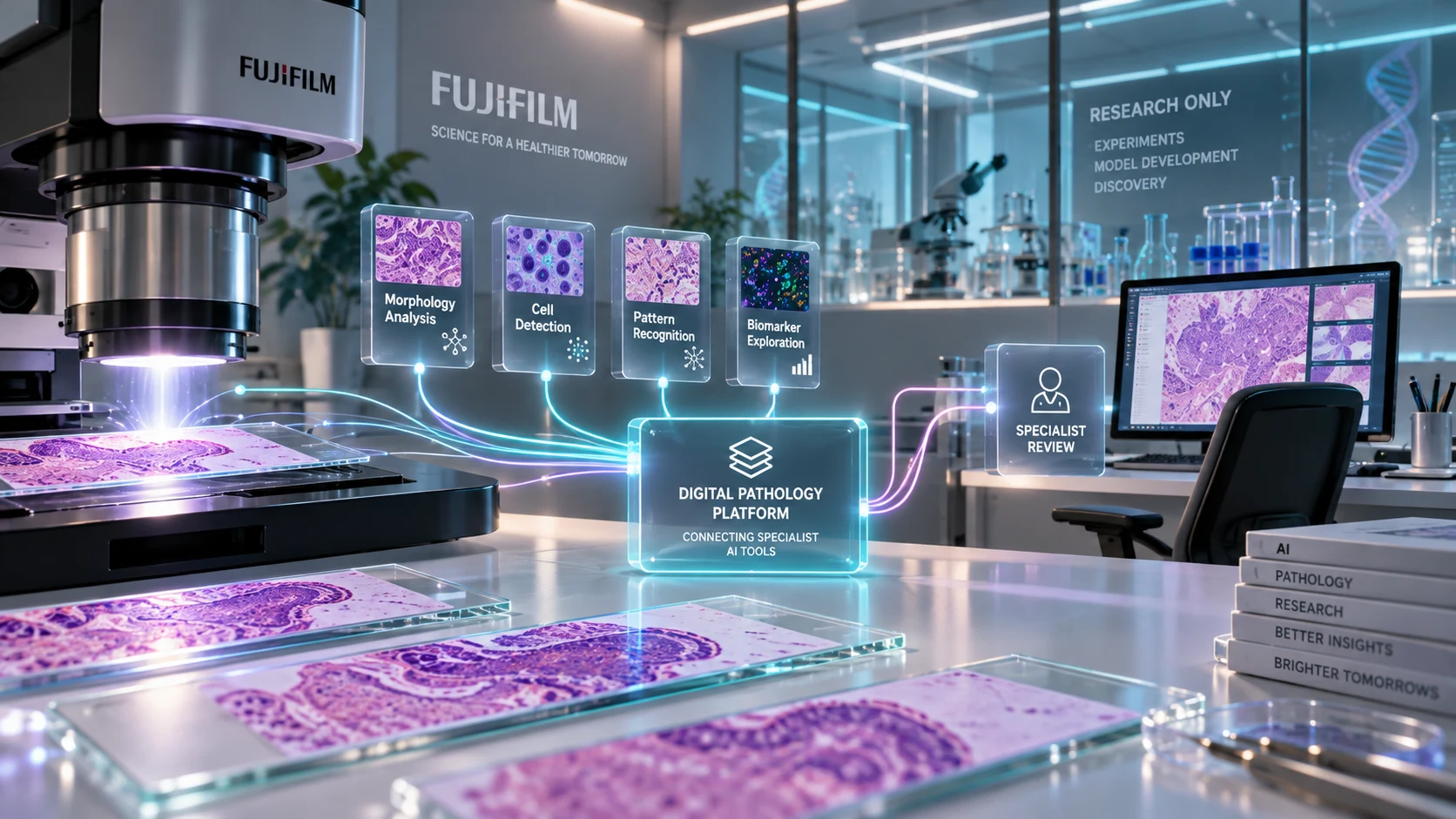
Fujifilm announced Synapse Pathology v3.0 on October 12, adding more than 50 features and functions to its digital pathology software. The release focuses on how pathologists organize, navigate, measure and discuss digital slides, while connecting the platform to more specialist AI applications. A separate pathology foundation model will be shown for research use only.
The workflow additions include Smart Worklist sorting, new navigation devices, slide tagging, measurement tools and improved collaboration tools. Fujifilm says these changes respond to customer feedback and aim to make digital case review easier. The announcement does not supply an independent measurement of time saved, diagnostic accuracy or clinical outcomes.
Synapse AI Orchestrator acts as a distribution hub between Synapse Pathology and compatible third-party AI applications. The practical aim is to exchange information without forcing pathologists to move between separate systems for every tool. Fujifilm names Ibex solutions for malignancy detection in prostate, breast and gastric specimens among the supported ecosystem. Compatibility with a named application does not establish that every AI tool works with the platform or that the entire workflow is cleared for every clinical use.
Fujifilm also describes enhancements to its proprietary TissueSync and TissueDirect algorithms. The release is a software and integration announcement, not a downloadable open-weight model launch and not evidence that an autonomous system can replace a pathologist. Connecting analysis tools is different from proving their accuracy or authorizing a clinical decision.
The separate Synapse Pathology AI Foundry is a pathology-specific foundation model that Fujifilm says was trained using millions of pathology images. A foundation model supplies a broader base for later applications rather than one narrowly defined task. The company plans to demonstrate screening of gastrointestinal specimens that distinguishes normal, inflammatory, atypical and malignant conditions at Pathology Visions, October 17-20 in San Diego.
That model is explicitly for research use only. The planned demonstration is not an announcement of approval for clinical diagnosis, broad commercial access or an FDA-cleared foundation model. Fujifilm uses a worldwide-first claim for the screening demonstration; this article does not independently verify that comparison. No accuracy benchmark, clinical-outcome evidence, public price or Indonesia availability is established in the release.
For a laboratory, the useful distinction is between evaluating the v3.0 workflow changes and treating a research demonstration as a deployable diagnostic product. The release points readers to product information and demonstrations, but does not provide a full compatibility matrix, regional rollout or terms for each third-party application. Those details still need checking for a particular laboratory and use case.
Source: Fujifilm Healthcare Americas company release dated October 12, 2026 https://healthcaresolutions-us.fujifilm.com/resources/press-release/fujifilm-launches-synapse-pathology-v3-0-advancing-the-digital-pathology-experience-with-expanded-ai-capabilities/ . Features, training scale and expected workflow benefits are issuer descriptions. The foundation model's research-use-only restriction is explicit in the source. The hero is an original conceptual illustration, not a product screenshot, real patient slide result or photograph of a clinical deployment.